
Founder Mindset
Why Founders Build Before They Validate
Why the keyboard feels safer than the phone — confirmation bias, action bias, sunk cost, and a small weekly habit that breaks the build-first loop.
· Updated · Yibud· 15 min read
On this page
- Key takeaways
- Why this matters
- Yibud's perspective
- Building Feels Like Progress
- Validation Feels Uncomfortable
- The Psychology Behind It
- How Builders Accidentally Fool Themselves
- The Cost of Building Too Early
- How to Escape the Trap
- A Weekly Validation Habit
- Frequently Asked Questions
- Common mistakes
- Related reading
- Sources
A developer once spent three months building an AI tool for personal finance coaches. The product was solid. The interface was clean. He had built most of it on weekends, with quiet pride. When launch day arrived, he posted on a few Slack groups, sent a newsletter to his network, and waited for the kind of response that would justify the work.
Nothing happened.
Not because the product was bad. Not because he wasn't talented. He had skipped the part of the work that would have told him, in week two, that the people he was building for had already duct-taped a solution out of Notion templates and a Telegram channel. By the time the launch landed, those coaches were using the workaround. They were happy with it. They were not looking.
He told me later that the failure didn't feel like an engineering failure. It felt like a personal one. That detail stayed with me.
I have my own versions of this story. Different products. Different domains. Same pattern. I would fall in love with the technical problem, lose months to a build that felt productive every day, and only realize in the last week of the project that I had been solving a problem that didn't exist for the people I imagined would use it.
This article is about the part of that pattern I didn't see for a long time. It's not about validation as a process. It's about the founder psychology that makes us reach for the keyboard when we should be reaching for the phone.
Most articles on this topic try to teach validation. This one is about why so few of us actually do it.
Key takeaways
- Building feels like progress; validation feels uncomfortable. The same number of hours spent coding produces commits, deployments, and screenshots. The same hours spent on customer interviews produces nothing visible. The first feels productive; the second feels empty.
- Three well-known psychological patterns drive the build-first reflex: confirmation bias (filter out signals that would change your mind), action bias (do something visible even when waiting is correct), and sunk cost fallacy (the longer you've built, the harder it is to stop).
- The cost of building before validating is more than time. It drains motivation, burns runway, and quietly erodes the founder's confidence. The most expensive weeks are the ones that felt productive.
- The escape is a small weekly habit, not a heroic effort. Monday review assumptions; Tuesday talk to one customer; Wednesday analyze feedback; Thursday run one experiment; Friday decide. The cadence makes avoidance visible.
- Knowing the lesson is not the same as applying it. Many founders who write about validation learned the lesson by failing. The discipline is doing the work the framework asks you to do, in the order it asks you to do it, before the building instinct takes over.
Why this matters
The hardest part of being a solo founder is not the technology, the market, or the fundraising. It is the part that happens inside your own head, in the moment you decide whether to write the next line of code or send the next message to a stranger. The default setting in every founder's nervous system is "build." That setting served a generation of founders who needed to ship software in an era when shipping was the bottleneck. It works against the generation of founders for whom shipping is trivial and finding customers is the actual work.
Recognizing the pattern is half the work. The other half is replacing the default with a small, repeatable cadence that survives a tired month. The cadence in this article is what makes the difference. Big changes are fragile. Small habits are not.
Yibud's perspective
Yibud is built around the assumption that the founder-psychology problem is real and under-addressed. Most validation tools treat the founder as a rational actor who will run the experiments if given the right framework. The framework is necessary; it is not sufficient. The product's design choices — short reports, deterministic scoring, no prediction language, an explicit refusal to score "is this a good idea" — are all aimed at supporting the founder who is in the middle of the build-first loop and needs a small, concrete reason to step out of it.
The platform will not tell a founder their idea will succeed. It will surface which of their assumptions is currently the riskiest, and it will do it in five minutes, in plain language, with no signup. That is the smallest version of the same interruption this article describes. It is not a replacement for the weekly cadence. It is a starting point for the Monday review.
Building Feels Like Progress
The first time I shipped a side project, I was seventeen. It was a small tool, half-finished, that did something nobody asked for. The act of typing code, watching the screen fill up, opening a tab to see the live version, all of it gave me the most reliable feeling I had ever felt about my own ability. The feeling was: I am doing something.
That feeling has a name. Psychologists call it perceived progress. The more visible the work, the more it registers as accomplishment. Writing code is extremely visible. Talking to strangers about a problem is invisible. Sending cold emails to people who might never reply is invisible. The first kind of work fills your day. The second kind of work makes your day feel empty.
This matters because the feeling of progress is not the same as the reality of progress. Building the wrong product feels exactly like building the right product. Both produce commits, deployments, and screenshots. Both feel like momentum. The difference only reveals itself at the end, when nobody shows up.
The trap is that this feeling is rewarded socially. Other developers admire the build. Friends compliment the speed. Online communities celebrate launches. Almost no one praises the founder who spent a week having conversations that produced no product, no logo, and no screenshots. The applause goes to builders. Validation, in the early days, happens in silence.
So we keep building. Not because we are naive. Because building is the only part of the work that gives us the reinforcement we need to keep going.
Validation Feels Uncomfortable
Every founder knows they should validate. Most of them have read at least one book or article that explained why. They nod along. They agree with the principle. Then they go back to building.
The reason is not that they don't believe validation works. The reason is that the work of validation is genuinely uncomfortable, in ways that are hard to admit and harder to fix.
You have to call, message, or email strangers. You have to ask them about a problem you suspect they have, which is a small confession that you don't already know the answer. You have to listen to criticism, or worse, polite agreement that means nothing. You have to hear the version of "I'm not really the right person" three times in a row without taking it personally. You have to admit, sometimes out loud, that the idea you have spent weeks thinking about might not be what those people need.
Then, if you do find someone interested, you have to ask them to pay you. Not in a survey. In real money. Real money is a different kind of test. It is the kind of test that produces a different kind of result, and most founders are not ready for what the result might be.
There is a quieter discomfort too. Talking to customers makes the work public in a way that building does not. While you are coding, the idea exists only in your head. You can still imagine it working. The moment you describe it to a stranger, you have to confront the gap between your mental model and theirs. That gap is almost always wider than you expect.
I have watched founders postpone customer calls for weeks. They have all kinds of reasons. The audience is hard to reach. The product isn't ready to talk about. The landing page needs one more revision. None of these are the actual reason. The actual reason is the discomfort. This is not a character flaw. It is a normal response to the most vulnerable part of starting a company. Founders who handle it well are not braver. They are just more willing to do small uncomfortable things on a regular schedule.
The Psychology Behind It
There are three well-known patterns in decision-making that show up again and again in early-stage startups. None of them are exotic. They are part of how every human brain works. The work is noticing them in yourself, not in a textbook.
Confirmation bias is the tendency to look for evidence that supports what you already believe. Once you have decided your idea is good, every signal gets filtered. A friend who says "cool idea" confirms the belief. A stranger who doesn't reply is "just busy." Your brain quietly edits reality to match the story you have already written. The result is that you can spend weeks "validating" without ever confronting the result that would change your mind.
Action bias is the pull toward doing something visible, even when the right move is to wait. Founders feel pressure to ship, to launch, to release the next feature. Every week of "just thinking and talking" feels like a week wasted. The pressure to act is mostly internal, but it is reinforced by the startup culture we live in, which celebrates building and treats waiting as weakness.
Sunk cost fallacy is the reason a founder who has built for three months rarely stops. The longer you have invested in an idea, the harder it becomes to admit the idea is wrong. They were not a mistake. They were a hypothesis. The mistake is letting the hypothesis outlive its useful life.
These three patterns interact. Action bias pushes you to start building. Confirmation bias filters out the signals that would tell you to stop. Sunk cost fallacy makes stopping feel like failure rather than learning. The combination is a self-reinforcing loop, and almost every founder I have met has been caught in some version of it.
The first step out is recognizing the loop while you are still inside it.
How Builders Accidentally Fool Themselves
The hardest part of being inside the loop is that it feels like clarity. You have a plan. You are executing the plan. The work is moving. From the outside, it looks like focus. From the inside, it feels like conviction.
Here are the most common ways this conviction turns out to be self-deception.
A landing page with no traffic. You spend a Saturday building a beautiful landing page for the product. You describe the value proposition. You add testimonials from people you haven't actually sold anything to. You launch it into the void. Nothing happens. The page is not the bottleneck. Distribution is.
Friends saying "great idea." This is the most common form of false validation. Friends are kind. Friends are curious. Friends want to support you. Friends are not your market. The market is full of strangers who have better things to do than be kind to you. The signal you want is a stranger who has not been pre-loaded with your enthusiasm reaching for their wallet, signing up with their real email, or giving you twenty minutes of their day for a conversation that benefits them.
Building more features instead of finding users. Every new feature feels like a small bet on the idea. "If I just add this, they'll come." The list of features grows. The list of actual users does not. They keep adding features because that is the work they know how to do. They avoid finding users because that is the work they don't.
Mistaking compliments for demand. The single most expensive sentence in a founder's vocabulary is "I told ten people about my idea and they all loved it." The test is not whether ten people in your immediate circle like the idea. The test is whether ten people you have never met will pay for, sign up for, or consistently use a thing that does not yet exist.
There is a more subtle form of this self-deception. It is the belief that you are still in the "early days" and that any of these signals would change if you just had a slightly better product. That belief is rarely true. Better products help, but they don't fix a problem that wasn't there to begin with.
The Cost of Building Too Early
The cost of building before validating is usually described as time. Time is the smallest part of the cost.
Time is the obvious one. Three months of work that turned out to be the wrong work. Six months. A year. Every founder I have talked to who eventually shipped something successful can name the months they spent on the wrong thing. They felt productive. They felt like the only honest thing to do. They were the most expensive weeks of the founder's life.
Motivation is less obvious. Each project that ends in a quiet launch drains a little from the well. The third or fourth time it happens, the founder starts to wonder whether they are cut out for this. The doubt is not about skill. It is about judgment. They keep thinking they are bad at choosing ideas, when in fact they are bad at checking ideas.
Money shows up in obvious ways (tools, hosting, design) and less obvious ways (income not earned while building the wrong thing, opportunities not taken). For a solo founder with a day job, opportunity cost is often the largest number on the spreadsheet.
Loss of confidence is the cost nobody talks about. The quietest failure is the one where the founder is not sure if they failed, but the absence of traction makes them hesitant to start the next thing. They take a long break. The cost is the months it takes to start again.
None of this is a reason to stop building. It is a reason to build more carefully. The right amount of validation is not zero and not six months. It is enough to know that the problem is real, the audience is reachable, willingness to pay is genuine, and the founder can actually ship.
How to Escape the Trap
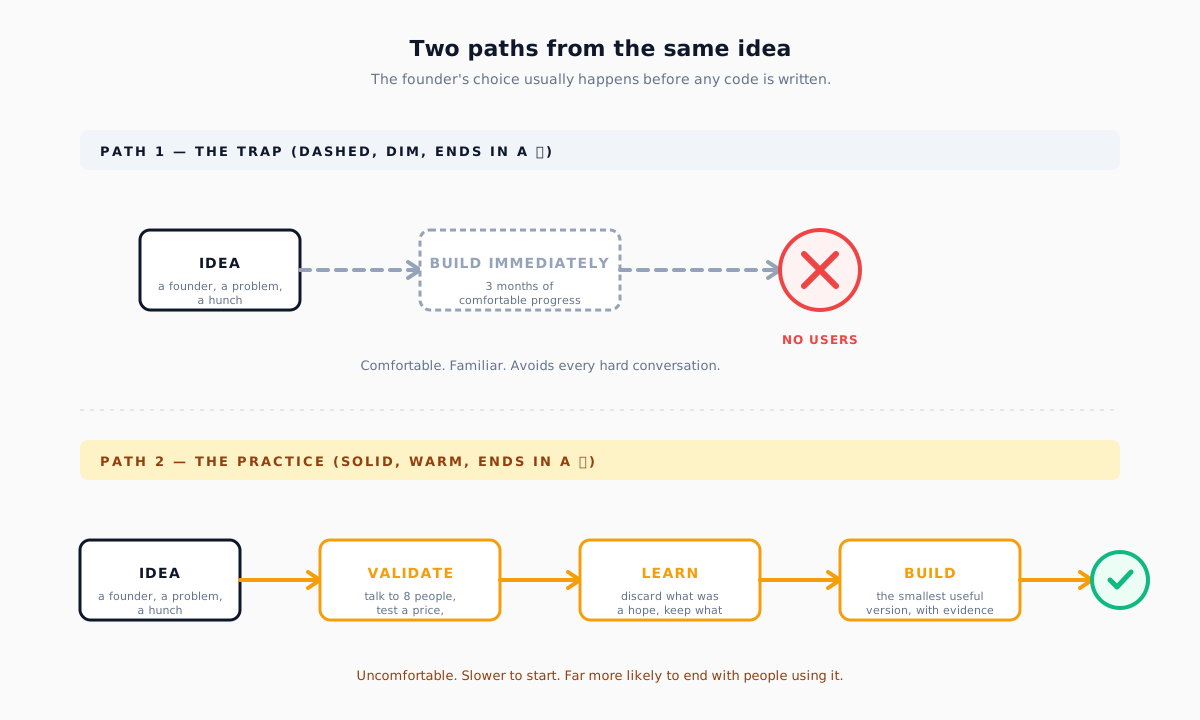
The trap is escapable. Not by working harder or reading more articles. By changing the order of operations.
For every new idea, before writing a single line of code, run through this sequence.
Write the assumptions down. Not in your head. In a document. List every assumption the idea depends on. The audience exists. The problem is frequent. People will pay this much. They can be reached through this channel. The founder can build this in 30 days. The list is usually longer than you think. Most ideas collapse the moment you put the assumptions on paper. That collapse is information.
Talk to customers. The people who experience the problem, not your friends, not your team, not your advisors. Eight to ten conversations is usually enough to find the patterns. Ask about their workarounds. Ask about the last time the problem came up. Ask what they tried. Don't pitch. Don't defend. Listen. The conversations will feel slow and unproductive for the first five. By the eighth, you'll start to hear the same phrases repeated. That repetition is signal.
Test payment. This is the step most founders skip, and the one that produces the most information. Pre-orders, deposits, paid waitlists, paid pilots — anything that puts a small amount of money between the customer and the product. Money is the strongest signal. You don't have to be selling the real product. You can be selling a manual version, a prototype, a future version with a refund policy. The form of the test matters less than the presence of money in it.
Build the smallest useful version. Once the assumptions have evidence behind them, build the smallest thing that solves the actual problem. Not the smallest thing you can ship. The smallest thing that does the job the customer described in the conversations. If those two are different, the customer description wins. The version you ship in week four is meant to teach you something, not to be the product.
Repeat. The first build is rarely the right one. Use it. Listen. Learn. Build the next version. The loop is not a sign of failure. The loop is the work.
The whole sequence, for a solo founder, takes two to four weeks. It costs less than the first month of hosting and design tools for the wrong product. The output is the decision: build this, pivot, or kill it. All three are valuable outcomes.
Different versions of this process have been described by people such as Steve Blank, Eric Ries, Rob Fitzpatrick, and Ash Maurya. The principles are remarkably consistent even if the terminology differs.
A Weekly Validation Habit
Big changes are fragile. Small habits are not. The change has to be small enough to survive a bad week, a tired month, or a year where the day job is demanding more hours.
Here is a simple weekly cadence that works for most solo founders. It assumes two to three focused hours per day.
Monday — review assumptions. Cross out anything you've already validated. Add anything you've learned since last week. Star the riskiest assumption. That starred assumption is the one the week is going to test.
Tuesday — talk to customers. One conversation, minimum. It can be a fifteen-minute call. It can be a coffee with someone in the target audience. The point is to have at least one human interaction with the future customer per week. The day doesn't matter. The consistency does.
Wednesday — analyze feedback. Pull together what you heard this week. Look for the phrases that came up more than once. Those are the patterns that should shape the next experiment. This is the day for thinking, not doing.
Thursday — run experiments. Pick the smallest experiment that could answer the most important question. A landing page. A cold email. A pre-order form. A pricing test. Run one. Don't run five.
Friday — decide. Make a small decision. Keep going, pivot, or kill. Every Friday. Not because the decision has to be big, but because the practice of deciding is what changes the way you think.
Weekend — build only what has evidence. This is the guardrail. The rule is simple: if the thing you're building is supported by evidence from the week, build it. If it isn't, it has to wait.
Some weeks the cadence will collapse. A customer cancels. A family event eats the Tuesday slot. The point isn't to be perfect. The point is to be honest about which parts of the work you are doing and which parts you are avoiding. The cadence makes avoidance visible.
There is a quiet part of this work that doesn't get talked about. Building is, for many founders, a way of being alone with a problem they understand. Validation is being with people, including people who will tell you the idea is wrong. The two activities require different versions of the founder. The first is the maker. The second is the listener. If the only version of yourself you can be while working on the business is the maker, you will keep making, even when the evidence is begging you to stop. The fix is a small set of habits: building only after you have listened, writing the assumptions down before you write the code, asking one more question before you push the next commit.
Frequently Asked Questions
Can I validate an idea without talking to people?
You can learn some things without conversations, but you cannot learn the most important things. Landing pages, ad tests, and search data can tell you whether a problem has volume. They cannot tell you whether the people who have the problem are willing to pay for your version of the solution, or what their current workaround looks like. If you cannot bring yourself to talk to people, that itself is information about the kind of business you are likely to build.
What if I'm an introvert?
Being an introvert and being unable to talk to customers are different problems. Many of the best customer researchers I have met are introverts. They prepared questions. They sent them in advance. They kept calls short. They wrote down answers. The conversations don't have to be long or charismatic. They have to be honest and frequent. Introverts often do better at this than extroverts, because they listen longer. The full conversation discipline — good questions, bad questions, the signals that separate polite audiences from early adopters — is in How to Find Your First Customers Before You Build.
How much validation is enough?
Enough to make the next decision. The decision is usually one of three: build, pivot, or kill. You don't need to eliminate all uncertainty. You need enough evidence to act. In practice, eight to twelve honest conversations and one or two payment tests will either kill the idea, push you toward a pivot, or give you enough signal to start building. If you have been validating for more than six weeks without converging on a decision, you are probably looking for certainty that doesn't exist.
When should I stop validating and start building?
When the riskiest assumption has been tested with real behavior, not just opinions. A signup is stronger than a compliment. A pre-order is stronger than a signup. A recurring payment is stronger than a pre-order. When the strongest signal you can produce is real and confirms the assumption, the next step is to build. If the strongest signal is a friend saying "cool idea," you have more validation to do. The framework for how those signals get produced lives in How to Validate a Startup Idea Before You Build; the condensed checklist version is in Startup Validation Checklist.
What if the validation says no?
Stop. Kill the idea. Move to the next one. The most expensive thing a founder can do is to keep building an idea that the market has quietly rejected. The cost of stopping is real and finite. The cost of continuing is open-ended. Most founders who have killed an idea describe it as the moment they got unstuck, even though it didn't feel that way at the time.
How do I avoid fooling myself with confirmation bias?
Make a habit of asking, before every experiment, "what result would change my mind?" If you cannot answer that question, you are not designing an experiment, you are looking for reassurance. A good test produces a result that can update your belief. A bad test produces a result that confirms it. The difference is in the design, not the data.
Why does every founder I read about talk about validating, and yet the same founders build for years before launching?
Confirmation bias, action bias, and sunk cost apply to advice-givers too. Many of the founders who tell you to validate learned the lesson by failing. The advice came after the failure, not before. The mistake is assuming that knowing the lesson is the same as applying it. Knowing is easy. Applying is the work.
Is there a version of validation that doesn't feel like selling?
Yes. The version where you are not selling. The goal of a customer conversation is not to close a deal. It is to understand a problem. The best validation conversations feel like the founder is a researcher, not a salesperson. The questions are about the customer's life, not about the product. The founder says less than the customer. If the conversation feels like a pitch, it is a pitch. If it feels like an interview, it is doing the work it is supposed to do.
Common mistakes
Six recurring ways founders try to escape the build-first loop without actually doing the work. Each one feels productive in the moment and produces no evidence.
Mistake 1 — "I'll validate after I have something to show." The minimum shippable version of the idea can become the excuse for never validating at all. The founder who waits for the demo to start the customer conversations has usually built a demo the customer did not ask for. The validation happens before the demo, not after.
Mistake 2 — Counting compliments as demand. "I told ten people and they all loved it" is the most common form of false validation. People who like you will say they like your idea. The signal you want is whether a stranger — someone with no reason to be kind — will pay, sign up, or give you twenty minutes of their day for a problem they actually have. The difference is the test, not the count.
Mistake 3 — Treating a landing page as a validation. A landing page with no traffic is not validation. A landing page that gets 1,000 unique visitors and a 2% signup rate is a useful signal — provided the visitors were reached through a channel that resembles the one you would use at launch. A landing page that gets twelve visitors from your Twitter followers is not a validation; it is a vanity metric.
Mistake 4 — Designing the experiment to confirm the hypothesis. The most expensive sentence in a founder's vocabulary is "I want to confirm that people want this." A test designed to confirm what you already believe will confirm it. A test designed to find the result that would change your mind is a real test. The discipline of naming the disconfirming result before you run the experiment is the cheapest insurance against fooling yourself.
Mistake 5 — Confusing activity with progress. A founder can spend a week having polite conversations and produce zero information. A founder can spend a week having three conversations with people who have the problem and produce a decision. The volume is not the work; the quality of the signal is. The weekly cadence in this article is built to make avoidance visible — a week with three real conversations is a week of progress; a week with twelve polite ones is not.
Mistake 6 — Reading one more article instead of doing the next experiment. The most common exit ramp from the discipline is the next article. There is always a smarter framework, a better checklist, a sharper founder essay that promises to make the next conversation easier. The framework does not get easier. The work does. The work is the call.
Related reading
- How to Validate Demand Before Coding — the practical bridge from "I want to skip the phone calls" to "here is the cheapest experiment that produces real evidence this week."
- How to Validate a Startup Idea Before Building — the canonical four-stage validation framework this article sits inside.
- Lean Startup Validation — the original Ries methodology, applied to the build-first reflex.
- Startup Validation Checklist — the operational checklist that turns the framework into a week-by-week plan.
- How to Find Your First Customers Before You Build — the conversation discipline that the weekly cadence in this article assumes.
- How to Test Whether People Will Pay Before You Build — the payment test that converts polite interest into real evidence.
- Why Founders Build Before Validating (the founder psychology piece in essay form, with the same framework applied at greater length).
- The Build-vs-Buy Decision for First-Time Founders — once the founder has decided the idea is worth building, the next question is whether to ship software, pay for it, or assemble a no-code stack. The four-question test that picks the path.
- Startup Failure Analysis — the post-mortem of the failure modes the build-first reflex tends to produce.
- The Mom Test Explained for Solo Founders — the canonical book on how to have the conversations the framework assumes.
- Startup Validation hub — the full reading path and topical taxonomy.
Sources
The founder-psychology framing in this article — confirmation bias, action bias, sunk cost, and the perceived-progress trap — draws on the following primary and secondary sources.
- Eric Ries, The Lean Startup (2011), especially Chapter 9 on Validated Learning — the original articulation of the build-measure-learn loop and the discipline of testing the riskiest assumption before building.
- Rob Fitzpatrick, The Mom Test (2013), free at momtestbook.com — the rule against asking "would you buy this?" The book's insistence that good customer research is uncomfortable and quiet is the foundation of the weekly cadence above.
- Steve Blank, The Four Steps to the Epiphany (2005) — Customer Development as the discipline of running the validation experiments outside the building process.
- Daniel Kahneman, Thinking, Fast and Slow (2011) — the System 1 / System 2 framing and the published evidence on confirmation bias; the article uses Kahneman's framework for naming the trap, not specific study numbers, because the underlying research is broader than any single citation.
- Daniel Kahneman and Amos Tversky, "Loss Aversion in Riskless Choice: A Reference-Dependent Model" (1991, Quarterly Journal of Economics) — the canonical sunk-cost-fallacy paper. The behavioural-economics framing in this article is rooted in the Kahneman-Tversky programme even where specific numbers are not quoted.
- Paul Graham, "Do Things That Don't Scale" (2013) — the essay that named the founder-psychology observation that doing the unscalable work is the path; relevant where the validation conversations in this article are themselves the unscalable work.
- Teresa Torres, Continuous Discovery Habits (2021) — the modern Customer Discovery methodology that the weekly cadence in this article mirrors.
- Ash Maurya, Running Lean (2012) — the discipline of validating the problem before the solution, including the published case studies behind the pattern.
If any of this sounds familiar, the next step is small. Tonight, write down the four riskiest assumptions behind the idea you are most tempted to build. Tomorrow morning, pick the riskiest one. Design the cheapest experiment that could prove it wrong. Run the experiment by the end of the week. Whatever you learn, you will be closer to a real answer than you are right now.
If you would like a structured second opinion on which assumptions are carrying the most risk before you start, Yibud's startup validation analysis can help. It is not a scoring tool. It is a way to put the assumptions on paper and see which ones you have not yet tested. The goal is not to validate an idea. The goal is to find out, before you spend months of your life, which idea is worth the months.
If you want a structured checklist for the work, the validation checklist walks through each stage with examples. If you would rather read the full sequence from problem to payment, the validation guide covers the whole loop. If your question is mostly about whether people will actually pay, the willingness-to-pay guide goes deeper on the payment test. And if you have decided the idea is worth building and your real problem is finding the first ten customers, the first-customers guide covers that next step.
The hardest part is not the framework. It is doing the work the framework asks you to do, in the order it asks you to do it, before the building instinct takes over. The founders who do it well are not smarter. They are just more honest, more often, about the gap between what they have built and what the market has actually asked for.
Continue learning
Where to go from here
These pieces are grouped by topic, not publication date — pick the one that matches the question you are working on right now.
More in Founder PsychologySee all topics →
Founder Mindset
The Build-vs-Buy Decision for First-Time Founders: When to Ship Software, When to Pay for It, and the Only Test That Picks
A first-time founder's guide to the build-vs-buy decision — when to pay for an existing SaaS, when to assemble a no-code stack, when to fork an open-source project, when to hire a contractor, and when the only honest answer is to build from scratch. The four-question test that picks the right path, the five situations where the answer is pre-decided, and the six-month read-out that proves which side was right.
14 min read
Founder Mindset
How to Position Against an Incumbent: The [for–unlike] Wedge That Holds When a Competitor Already Owns the Category
A founder's guide to writing a positioning wedge when a more-funded, more-distributed competitor already exists in the category — April Dunford's five-component positioning, the four wedge types (segment, persona, capability, distribution), the [for–unlike] sentence template, the five cheap tests that catch a positioning that won't hold, and the failure modes that produce a wedge the team cannot defend in a sales call.
17 min read
Next in the reading path
How to Position Against an Incumbent: The [for–unlike] Wedge That Holds When a Competitor Already Owns the Category
A founder's guide to writing a positioning wedge when a more-funded, more-distributed competitor already exists in the category — April Dunford's five-component positioning, the four wedge types (segment, persona, capability, distribution), the [for–unlike] sentence template, the five cheap tests that catch a positioning that won't hold, and the failure modes that produce a wedge the team cannot defend in a sales call.
How to Validate a Startup Idea Before You Build
The four assumptions every startup depends on, the four questions that test them, and the cheapest experiments that produce evidence in 2–4 weeks — before you build.
Problem-Solution Fit: How to Know Your Solution Solves a Real Problem Before You Build It
Problem-solution fit is the state where a defined customer has a defined problem and a defined solution would meaningfully improve their situation. The five rungs of evidence that prove the fit is real, the six failure modes that show it isn't, and the 14-day validation framework that separates real pain from polite enthusiasm.
See every article on startup validation in one place.
Open the Startup Validation hub →